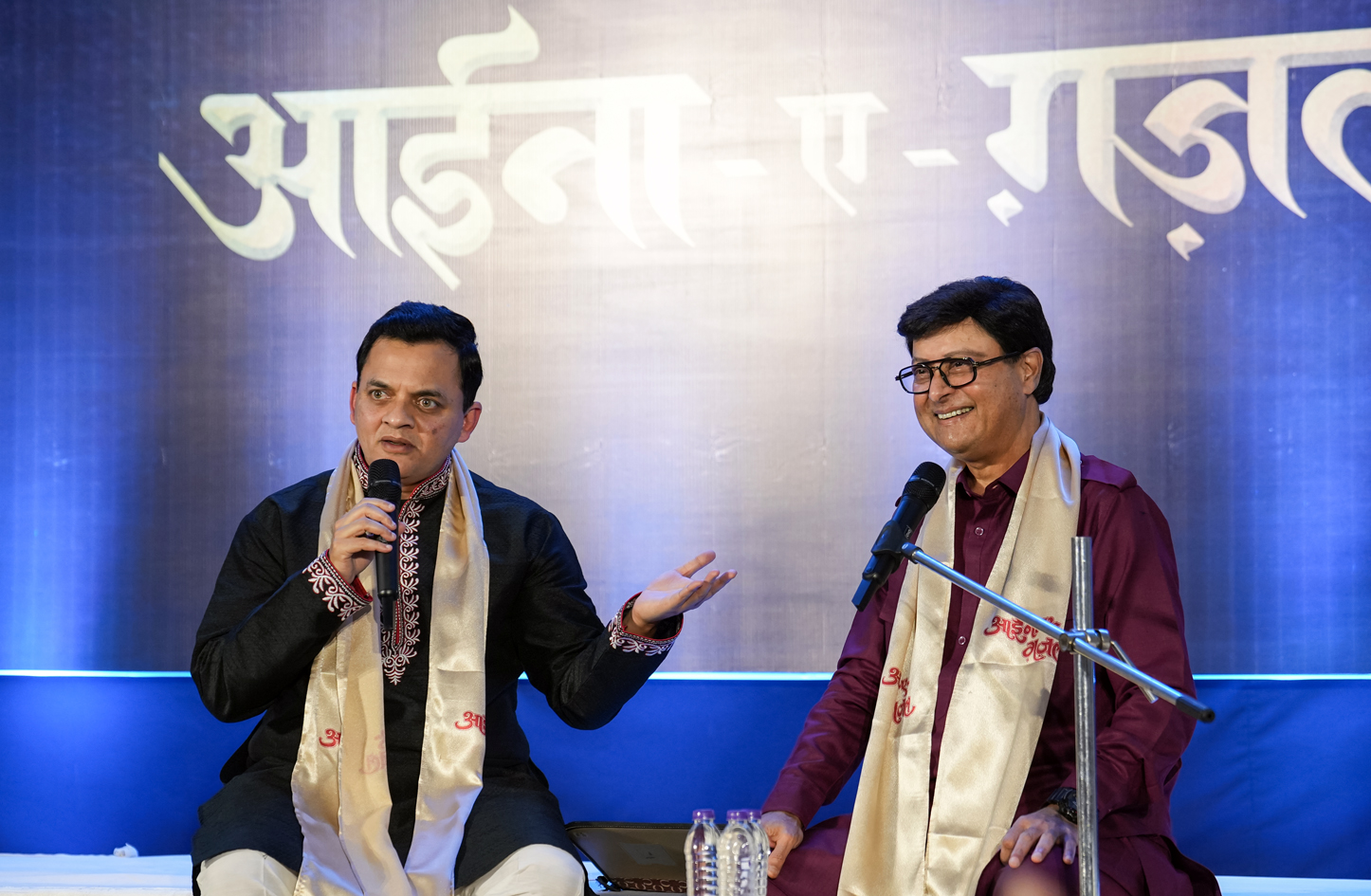
Pilgaonkar, known for his versatility across cinema and theatre, surprised many with his effortless command over Urdu ghazals, nazms, and couplets. His confident rendition of “Main qatra hi sahi, mera wajood toh hai, dua kare jo samandar meri talaash mein hai” set the tone, earning sustained applause and underlining his sensitivity as a performer beyond the screen.
Organised in memory of Dr Vinay Waikar, the free-to-attend programme was held at S M Joshi Auditorium, Navi Peth, where poetry lovers experienced multiple hues of shayari through carefully curated sessions. On the occasion, Pilgaonkar released Dr Waikar’s books ‘Aaina-e-Ghazal’ and ‘Gulistan-e-Ghazal’, in the presence of poet Vaibhav Joshi, organisers Amit Waikar and Aparna Waikar, ghazalkaar Sureshkumar Vairalkar, and other literary figures. Milind Kulkarni compered the event.
In an engaging segment titled ‘Andaaz-e-Shayari’, Pilgaonkar spoke about his long-standing love for Urdu, crediting legends like Meena Kumari and Majrooh Sultanpuri for shaping his aesthetic sensibility. His observation that Urdu continues to thrive largely because of its non-Muslim admirers drew warm applause. Alongside serious poetry, he also presented witty, satirical verses touching upon contemporary social media culture, adding a lighter note to the evening.
The programme opened with ‘Mushaira Ghazalrang’, featuring Vaibhav Joshi, Vaibhav Deshmukh, Mamata Sapkal, and Dnyanesh Patil, with Sureshkumar Vairalkar anchoring the session. This was followed by poet Rajesh Reddy’s ‘Bazm-e-Sukhan’, where his reflective ghazals — including “Kisi din zindagani mein karishma kyun nahin hota…”, struck a chord with the audience.
The musical dimension of the mehfil came alive in ‘Nagma-e-Ghazal’, presented by vocalist Prajakta Savarkar Shinde, who rendered ghazals by Nasir Kazmi, Shakeel Badayuni, Rajesh Reddy, popular film lyrics, and a Marathi ghazal by Vaibhav Joshi. She was ably supported by Mahesh Salunke on tabla, Ninad Solapurkar on harmonium, and Prabhanjan Pathak on violin.
The finale belonged to Vaibhav Joshi, whose ‘Sobaticha Karaar’ performance, backed by a full ensemble of musicians including Ninad Solapurkar, Prasad Joshi, Sameer Shivgar, Milind Shevare, Dattaprasad Ranade, and composer Dr Ashish Mujumdar, drew repeated calls for encores. From introspective verses to emotionally resonant lines like “Aayushyala ghabarnyacha swabhav nahi aai”, the evening culminated on a soulful bhairavi.
With packed halls and rapt attention through the day, ‘Aaina-e-Ghazal’ stood out as a significant cultural confluence, celebrating the shared legacy of Urdu and Marathi poetry in Pune’s vibrant literary circuit.